Thoth Tarot · History & Symbolism · 14 min read · 2026
The Thoth Tarot: How Aleister Crowley and Frieda Harris Turned a Deck of Cards into a Map of Modern Occultism
Created during the Second World War by two people of strikingly different temperaments and biographies, the Thoth Tarot wove together Hermeticism, Kabbalah, astrology, alchemy, Thelema, avant-garde art, and projective geometry. The story of this deck explains not only its complexity, but its uncanny ability to remain vital more than eighty years after its imagery took shape.
Written by: Anna Svitla
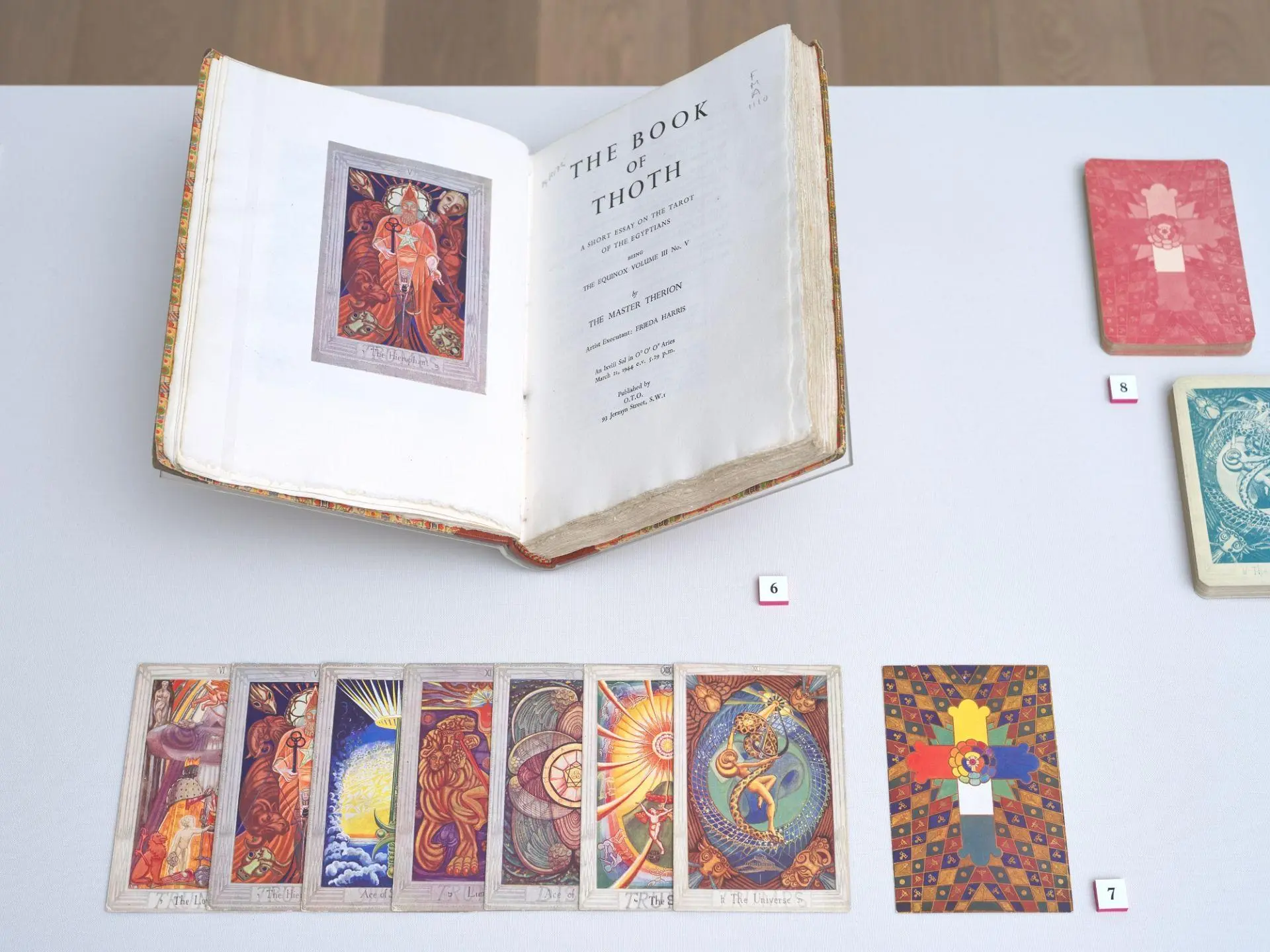
In June 1941, Frieda Harris prepared to show a series of unusual paintings in Oxford — not quite abstractions, not quite religious icons, and far more than mere card illustrations. The exhibition at Nicholson & Venn gallery was cancelled literally on the eve of its opening; the display had to be relocated to the Randolph Hotel. Exhibition catalogues and archival records preserve the traces of a story in which war, financial strain, and Aleister Crowley’s notoriety repeatedly threatened a project that had long outgrown a simple plan for a new Tarot deck.[7]
Initially, Crowley and Harris envisioned the undertaking as a relatively brisk modernization of traditional cards. In the end, it took roughly five years. Crowley died in 1947, Harris in 1962, and a complete printed deck reached wider audiences only in the late 1960s. Their collaboration outlived both creators — and stands today among the most influential esoteric Tarot decks of the twentieth century.[6][11]
01
A Deck Born Between War, Modernism, and Occult Revival
To understand the Thoth Tarot, it helps first to set aside one of the most persistent myths surrounding Tarot itself. Historical evidence does not confirm that playing cards originated in Ancient Egypt or preserve a secret book of ancient priests. The earliest reliable references to tarocchi belong to fifteenth-century Northern Italy; it began first and foremost as a trick-taking card game with added trumps. The systematic link between Tarot, occultism, and divination emerged much later — in eighteenth- and nineteenth-century France.[12][13]
It was then that Antoine Court de Gébelin proclaimed Tarot a surviving fragment of ancient Egyptian wisdom. His contemporary, the Comte de Mellet, directly connected the cards with the “Book of Thoth” — the mythical compendium of the god of writing, knowledge, and magic. Soon after, Etteilla — Jean-Baptiste Alliette — turned that hypothesis into a full-fledged system of cartomancy and, in the 1780s, presented Tarot as the Livre de Thot. Today historians view this not as the actual origin of the cards, but as one of the foundational myths of European occultism.[12][16]
The irony is that Crowley knew this tradition thoroughly while simultaneously being unable to verify it historically. Near the opening of The Book of Thoth, he himself calls the origin of Tarot “very obscure” and avoids choosing definitively between Egyptian and alternative theories. Yet the title Thoth Tarot and the book’s subtitle — A Short Essay on the Tarot of the Egyptians — deliberately extend the esoteric lineage of Court de Gébelin, Etteilla, Éliphas Lévi, and the Hermetic Order of the Golden Dawn.[1][11]
Egyptian Thoth matters here not as the “historical author” of Tarot, but as an archetype. In ancient Egyptian religion, Thoth governed writing, reckoning, knowledge, and intellectual inquiry; he was depicted as an ibis, a baboon, or an ibis-headed figure. In Greco-Roman antiquity he was identified with Hermes, and later with Hermes Trismegistus, around whom the Hermetic corpus crystallized. For Crowley, that made Thoth a nearly ideal patron for a system aiming to be at once a book of symbols, an instrument of cognition, and a model of the cosmos.[12][16]
Aleister Crowley: Not a “Satanist with a Deck,” but a Syncretic Systematizer
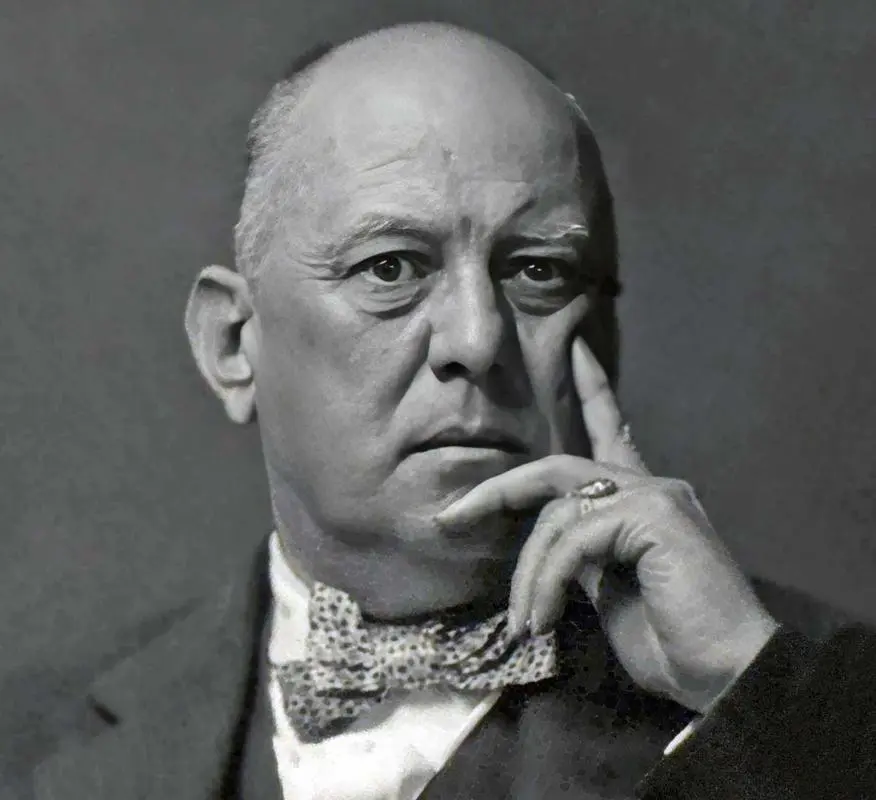
Born in 1875 into a devout Plymouth Brethren family, Aleister Crowley sharply rejected the strict Christian milieu of his youth. In the late 1890s he joined the Hermetic Order of the Golden Dawn, studying ceremonial magic, the Kabbalistic Tree of Life, astrological attributions, and occult Tarot symbolism. He later published key portions of Golden Dawn teaching, notably the correspondence system of Book T, which became one of the primary genetic codes behind both the Rider–Waite–Smith deck and the future Thoth Tarot.[3][9]
In 1904 in Cairo, Crowley produced the text he titled Liber AL vel Legis, or The Book of the Law. According to his own esoteric account, the book was dictated by a praeterhuman intelligence named Aiwass; a historian of religion, by contrast, treats this as Crowley’s own religious claim rather than an established historical event. Out of that text grew Thelema — a religious and philosophical current best known for the dictum “Do what thou wilt shall be the whole of the Law.” For Crowley, “will” never meant impulsive whim, but the discovery and fulfillment of True Will — one’s authentic trajectory of existence.[4][9]
Even by the standards of Western esotericism, Crowley’s intellectual world was strikingly eclectic. Kabbalah sat alongside astrology, alchemy, ceremonial magic, Indian yoga, Buddhist concepts, Daoism, the I Ching, numerology, and contemporary debates in science, psychology, and comparative religion. Scholars of Western esotericism therefore view him not merely as a flamboyant occultist, but as one of the pivotal figures through whom nineteenth-century esoteric traditions were re-engineered for the twentieth century.[9][10]
The Thoth Tarot became, in effect, the late encyclopedia of that worldview.
Frieda Harris: The Artist Without Whom “Crowley’s Tarot” Would Not Exist
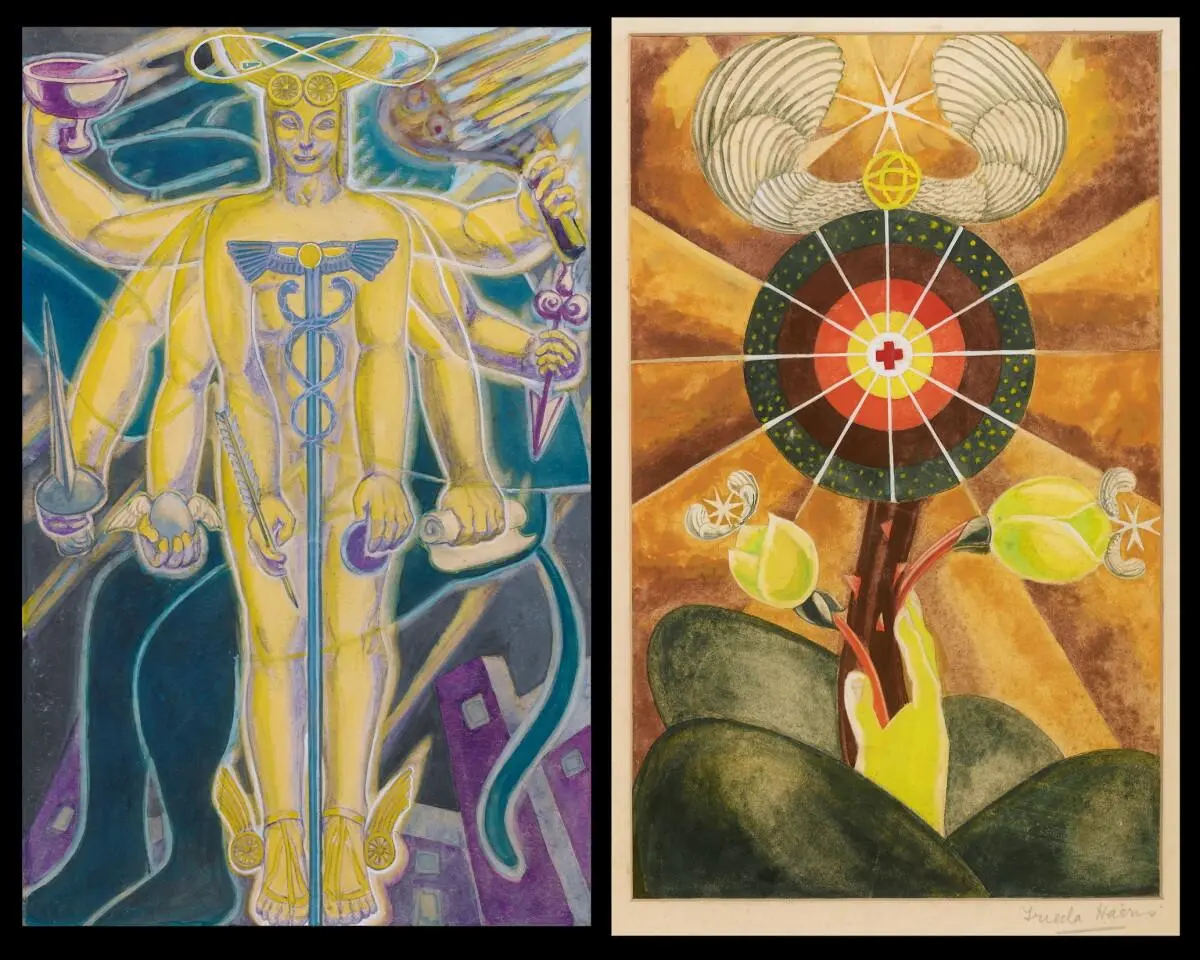
Calling the deck merely “Crowley’s Tarot” is historically unfair. Marguerite Frieda Harris (née Bloxam), born in 1877, was married to the Liberal politician Sir Percy Harris and entered her collaboration with Crowley at roughly sixty years of age. Recent scholarship by Deja Whitehouse — drawing on diaries, correspondence, and Warburg Institute archives — demonstrates that her role extended far beyond executing another person’s sketches.[6]
Clifford Bax introduced Harris to Crowley in 1937, and intensive work ran from 1938 through 1943. Harris did far more than paint: she subsidized part of Crowley’s living expenses, arranged exhibitions, sought printing funds, argued with him over compositions and card titles, insisted on revisions, and effectively pushed him away from a cosmetic update toward a coherent new system.[6][11]
In her letters she sounds nothing like a passive disciple. In September 1939, Harris wrote candidly to Crowley that his proposed new card titles struck her as overly grandiose and muddled. In another letter she offered a nearly programmatic formula: “The Tarot is an Atlas”. That phrase captures her own vision of the project cleanly: not a list of rigid dictionary meanings, but an interconnected spatial map of images.[5][8]
Crucial to that vision was Harris’s study of projective geometry under George Adams and Olive Whicher, figures linked to Rudolf Steiner’s Anthroposophical circle. Her correspondence reveals that geometry was no decorative flourish: Harris wanted to master spirals, lemniscates, and projective transformations of the plane. That discipline accounts for the unmistakable sensation of the Thoth Tarot: pictorial space appears to curve, converge in focal nodes, and unfold across multiple dimensions at once.[6][7]
This highlights a fundamental contrast between Harris and Pamela Colman Smith. Both artists worked alongside occult authors, yet Smith largely transformed Tarot into a theater of human vignettes, whereas Harris turned it into near-cosmological abstraction. Where Rider–Waite–Smith invites the viewer to read a narrative scene, Thoth asks the reader to trace a diagram of interacting forces.[14][11]
02
“The Book of Thoth”: Not a Deck Manual, but Its Operating System
The Book of Thoth appeared in 1944 as The Equinox, volume III, number V, in a small limited print run. The original volume was an opulent physical artifact adorned with Egyptian motifs, with surviving copies signed by Crowley himself. Inside, it brings together Tarot theory, expositions of the Major and Minor Arcana, Kabbalistic and astrological attributions, court card profiles, divinatory method, and dense philosophical digressions.[1]
Crowley begins with a simple arithmetic fact — 78 cards divided into 22 trumps and 56 cards across four suits — yet almost immediately translates arithmetic into metaphysics. For him, Tarot’s architecture mirrors the Kabbalistic Tree of Life: ten sephiroth, twenty-two connecting paths, Hebrew letters, planets, zodiac signs, and classical elements. This is not historical provenance; it is an esoteric model largely inherited from the Golden Dawn and thoroughly recast by Crowley.[1][3]
In Thoth, the four suits are Wands, Cups, Swords, and Disks. That final choice is deliberate: rather than coins or pentacles, Crowley chooses “disks” to signify matter and the element of Earth in its broadest cosmological sense. The court ranks are Knight, Queen, Prince, and Princess, departing from Rider–Waite–Smith’s King, Queen, Knight, and Page. Crowley maps these four figures onto the Tetragrammaton (YHVH) and elemental combinations — so a single court card might operate as “the fire of Water” or “the air of Fire.”[1]
The Minor Arcana function very differently from Rider–Waite–Smith as well. Pamela Colman Smith gave most numbered cards concrete human scenes — people arguing, working, celebrating, enduring loss. Harris, by contrast, builds compositions out of suit emblems, geometric lattices, color fields, and astrological glyphs. Crowley pairs them with terse titles such as Sorrow, Worry, Debauch, Victory, Wealth. Rather than serving as blunt predictions, those titles act as compressed formulas of each card’s astrological and Kabbalistic intersection.[1][3]
Multiple frameworks interlock here simultaneously. A card’s number corresponds to a sephirah on the Tree of Life; its suit aligns with an element; the cards from Two through Ten span the 36 decans of the zodiac; and the court cards govern specific zodiacal sectors. Alchemy surfaces wherever opposites unite, dissolve, and coagulate into new substance. That is why anyone trying to memorize Thoth solely from keyword lists quickly senses a far larger architecture behind the cards.[3][1]
03
Cards That Reveal the Entire Architecture of the Deck
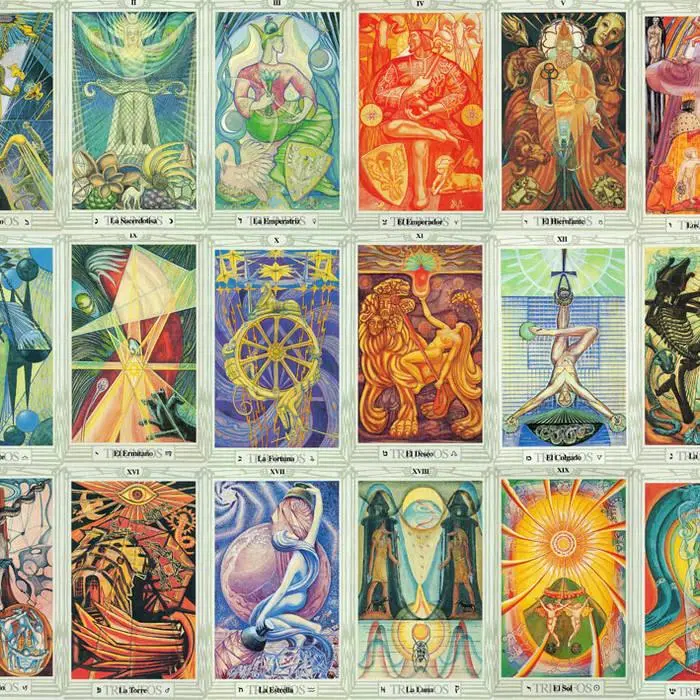
Lust (XI). Earlier decks associate this position with Strength. Crowley renames it Lust, framing it not as polite restraint over raw impulse, but as fierce joy in vital force itself. At the center of Harris’s painting sits a female figure identified with Babalon riding a many-headed Beast. The composition intentionally discards the moral cliché of “civilized reason taming animal instinct”: vitality is neither suppressed nor domesticated, but embraced and transmuted. It is a textbook example of Thelema rewriting the Christianized moral grammar of older Tarot.[2][12]
Adjustment (VIII). Whereas Rider–Waite–Smith places Justice at XI and Tarot de Marseille assigns it to VIII, Crowley returns to the eighth position while transforming its conceptual core. Adjustment is not a courtroom verdict handed down by an external moral authority, but precise equilibrium between forces and consequences. In his mnemonic formula he captures it through rhythm and exact counterbalance; in Harris’s brushwork the figure looks less like a static judge than a dynamic mechanism of scales in motion.[2][8]
Art (XIV). Few cards illuminate the alchemical core of Thoth more clearly. In Marseille and Rider–Waite–Smith, XIV is Temperance — an angel pouring liquid between two vessels. Crowley sees here not merely the virtue of moderation, but alchemical coniunctio, the marriage of opposites. Fire and water, masculine and feminine, red and white do not cancel each other out; they fuse into a third reality. Thus Art does not counsel “be moderate,” but “learn to forge contradiction into a higher synthesis.” Academic analysis of Crowley’s card titles explicitly links this shift to his break with classical cardinal virtues.[11][12]
The Aeon (XX). Classic Tarot places Judgement here: an angel blows a trumpet as the dead rise from their graves. For Crowley, such Christian eschatology no longer matched the “New Aeon” of Thelema, so the Last Judgment becomes an epochal shift in cosmic regime. Harris populates the card with Nuit, Hadit, and Ra-Hoor-Khuit — the central deities of The Book of the Law. It marks one of the boldest interventions in the deck: a familiar scene of resurrection replaced outright by the mythology of a twentieth-century religious movement.[2][4][12]
The Fool (0). Even this opening card reveals why Thoth resists a quick “one-glance” reading compared with Rider–Waite–Smith. Packed into the visual field are a tiger, crocodile, grapes, dove, butterfly, horns, spirals, and geometric vortices. For Crowley, the card embodies Air, primal indeterminacy, pure potential, ecstasy, and the paradox of zero; for Harris, the figure seems suspended within an active field of radiating energy. Contemporary museum curators routinely note the extraordinary symbolic density compressed into this single painting.[11][2]
Here Harris’s artistic power is unmistakable. She never tried to tuck occult attributions discreetly into margins. Instead, pigment, plane, spiral, ray, and symmetry become the carrier of meaning. Her pictorial space defies conventional perspective: forms overlap, figures dissolve into geometry, and line behaves almost like musical polyphony. Art historians connect this visual idiom with projective geometry, Anthroposophical study, surrealism, and the broader interwar British modernist milieu.[6][11]
04
Thoth, Rider–Waite–Smith, and Marseille: Three Distinct Ways of Thinking Through Cards
These three traditions are best compared not by asking “which one is right,” but by examining how each organizes meaning.
The Tarot de Marseille preserves the morphology of early modern European decks: figurative trumps paired with largely unillustrated pip cards. A Five of Coins depicts five suit emblems rather than a ready-made human drama. Meaning emerges primarily from number, suit, spatial placement, and reading lineage. Recent research from the Bibliothèque nationale de France also reminds us that the label “Tarot de Marseille” itself solidified much later, and early related decks were printed across several European centers beyond Marseille.[15][13]
The 1909 Rider–Waite–Smith deck dramatically expanded narrative illustration across the Minor Arcana. Instead of abstract suit arrangements, Pamela Colman Smith painted human scenes that allow readers to trace a story without memorizing elaborate tables of correspondences. That accessibility explains its vast cultural reach: a Nine of Swords showing someone waking in distress, or a Five of Pentacles depicting two destitute figures, immediately supplies a recognizable human storyline.[14]
Thoth charts a third course. Like RWS, it illustrates all 78 cards, yet repeatedly trades domestic vignettes for symbolic architecture. Where RWS asks “what is happening here?”, Thoth tends to ask “what forces are interacting here?”. That orientation helps explain its appeal among practitioners more interested in states of mind, tensions, motives, and transitions than literal event forecasting — though that is an observation about how readers use the deck, not an empirical property of the cards themselves.[1][17]
The divergence stands out sharply in Strength / Lust. In Rider–Waite–Smith, a woman gently closes or calms the lion: an image easily read as quiet poise, inner fortitude, and self-mastery. In Thoth, Lust is overtly erotic, ecstatic, and far closer to Dionysian vitality. In Marseille, La Force follows an older iconographic lineage in which a woman holds open the lion’s jaws. Crowley does not merely restyle the card — he shifts its moral center.[2][14]
The same holds for Judgement / Aeon. In Marseille and RWS, the imagery invokes Christian resurrection and a final reckoning; in Thoth, it becomes a manifesto of Thelemic historiosophy. Likewise, Temperance / Art pivots from sober moderation to alchemical transmutation. Precisely in such conceptual pivots, Thoth proves to be far more than a familiar deck wearing different artwork.[12]
05
How to Read the Thoth Tarot — and Why Its Difficulty Is Overstated
Thoth’s reputation as a “difficult deck” rests on real foundations. A single card may integrate a Hebrew letter, zodiac sign, planet, element, sephirah, alchemical operation, Thelemic myth, and Harris’s own compositional geometry. Nor was The Book of Thoth written as a modern beginner’s primer: Crowley leaps briskly from Kabbalah to mathematics, and from alchemy to classical mythology, assuming broad cultural literacy.[1]
Yet it does not follow that a reader must master the entire Golden Dawn curriculum before touching the cards. On the contrary, Harris herself thought of the painted image as a direct visual vehicle for ideas. Practically, that means reading can unfold in layers: first composition and color, next the card title, then element and astrological signature, and only afterward Kabbalistic or Thelemic depth. That rhythm resembles looking closely at a complex modernist painting far more than cramming a dictionary.[11][6]
In consultation work, Thoth is especially well suited to questions where what matters is not a binary “yes/no” answer, but the configuration of forces: inner conflict, recurring relational patterns, hidden motivation, choosing between two paths, creative blocks, shifting professional roles, boundaries of responsibility, or one’s stance toward authority, money, and desire. That does not mean the deck solves such dilemmas “better” in any objective sense; rather, its dense symbolic structure naturally supports nuanced interpretive dialogue. Qualitative research on Tarot practice confirms that readings operate through collaborative meaning-making between reader and client.[17][19]
Here an essential boundary deserves stating clearly. Science has not confirmed any ability of Tarot to predict the future. Academic studies of divination explain its effects through cognitive, cultural, communicative, and symbolic mechanisms; empirical experiments have likewise shown that how persuasive a personal reading feels is not equivalent to objective accuracy. At the same time, that does not render Tarot culturally “empty”: cards can serve powerfully as an imagistic language, a vehicle for self-reflection, or a narrative and projective prompt — provided they never substitute for evidence-based psychological or medical care.[18][19][20]
Several persistent myths around Thoth dissolve in this light. Historically speaking, it is not a “satanic deck”: Crowley certainly engaged provocative motifs like the Beast, Babalon, and the Devil, yet they belong inside his own Thelemic cosmology rather than orthodox Satanism. It is not more “dangerous” than any other deck in any empirically demonstrable sense. Nor does it strictly require reversed cards: Crowley’s system relies so heavily on card interactions and elemental dignities across a spread that many Thoth practitioners work exclusively with upright positions — a common reading convention rather than an ironclad law.[1]
Another enduring stereotype claims the deck belongs to Crowley alone. Contemporary scholarship on Harris steadily dismantles that single-author model. Her contribution was financial, organizational, intellectual, and painterly; several cards went through repeated iterations, and her projective geometry cannot simply be deduced from Crowley’s written notes. Today, the history of Thoth is far more accurately read as genuine — if turbulent and asymmetrical — co-creation.[6][7]
Crowley never lived to see a mass-market edition of the deck. The book appeared in 1944, while a full-color printed deck reached broad circulation only decades later, with 1969 widely cited as the first complete commercial edition. Since then, Thoth has remained one of the landmark decks descending from the Golden Dawn lineage.[6][11]
Its cultural afterlife has long spilled beyond occult bookshops. Harris’s original paintings are housed at the Warburg Institute; in 2025 they anchored the major exhibition Tarot: Origins & Afterlives, and in 2026 Crowley and Harris’s Tarot joined Tarot! Renaissance Symbols, Modern Visions at The Morgan Library & Museum alongside Renaissance decks and contemporary artists. That shift in framing is telling: increasingly, the deck is studied not only as an esoteric instrument, but as a significant monument of twentieth-century visual culture.[11][12]
Perhaps that explains the quiet secret of its durability. The Thoth Tarot was conceived as a system of definitive correspondences — almost a cosmic periodic table. Yet thanks to Frieda Harris, what emerged was not a closed chart, but a living visual environment no single interpretation can exhaust. Crowley set out to codify his “New Aeon”; the artist forged images resilient enough to outlast his doctrine.
For anyone picking up the deck for the first time, that suggests the healthiest point of entry: resist the urge to “decode everything” on day one. Notice instead what a card does with your attention. Which forces converge inside the frame? Where does the composition tighten into tension, and where does it settle into poise? Only after sitting with the image should you open Crowley, an astrological table, or the Tree of Life.
If you want to approach the Thoth Tarot not as a rigid glossary of stock answers, but as a living system of images and relationships, private training or an individual session with Anna Svitla offers a structured way to read your question — or master the deck — without getting lost alone in Crowley’s labyrinth of terminology.
Want to explore the Thoth Tarot through private training or a focused session?
Sources & Further Reading
- [1]
- [2]
- [3]Aleister Crowley / Golden Dawn, A Description of the Cards of the Tarot with Their Attributions, The Equinox I:8: Hermetic Library.
- [4]
- [5]
- [6]Deja Whitehouse, In Search of Frieda Harris, PhD dissertation, University of Bristol: Repository record and Full dissertation PDF.
- [7]Deja Whitehouse, The Lady and the Beast: The Extraordinary Partnership between Frieda Harris and Aleister Crowley, Oxford University Press, 2024, chapter “The Book of Thoth”: Oxford Academic.
- [8]Matthew Fletcher, “The Cardinal Importance of Names: Aleister Crowley and the Creation of a Tarot for the New Aeon”, Aries, 2020: Brill / DOI.
- [9]Henrik Bogdan & Martin P. Starr eds., Aleister Crowley and Western Esotericism, Oxford University Press: Oxford Academic.
- [10]Marco Pasi, Aleister Crowley and the Temptation of Politics, Cambridge University Press: Cambridge Core.
- [11]
- [12]The Morgan Library & Museum, Tarot! Renaissance Symbols, Modern Visions: Exhibition and Occult Tarot.
- [13]Metropolitan Museum of Art, “Before Fortune-Telling: The History and Structure of Tarot Cards”: The Met.
- [14]
- [15]
- [16]Wellcome Collection, Etteilla, The Tarot, in the form of leaves of the book of Thoth…, 1780s: Object record.
- [17]Charles Mason Olbert, Divination Practices: An Empirical Psychological Investigation, Fordham University: Fordham Research Commons.
- [18]
- [19]
- [20]Michael Loewe & Carmen Blacker eds., discussion of evidentiary limits of divination in Divination and Oracles: Oxford Academic.